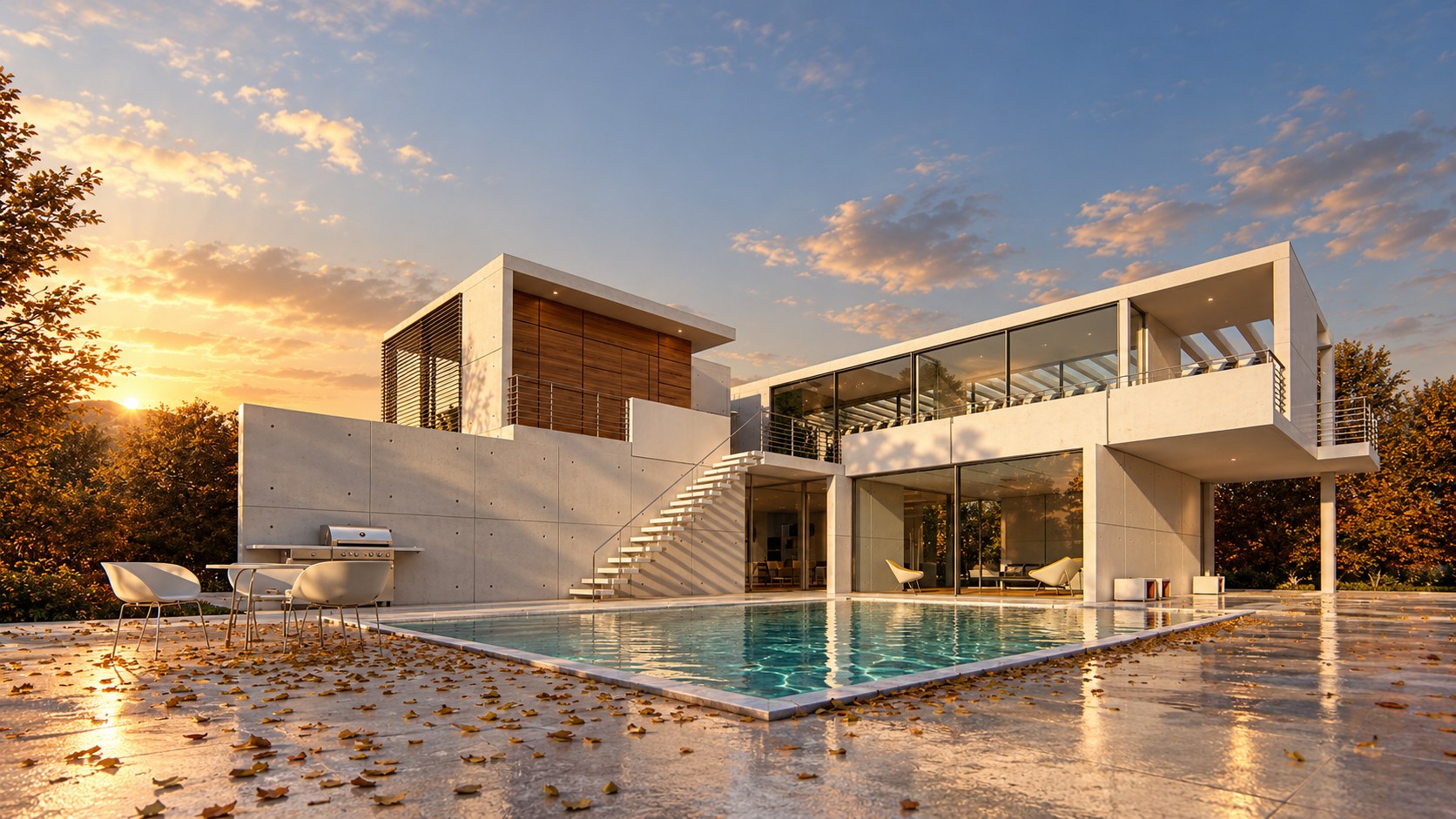
The cost of 3D architectural rendering depends less on the software and more on scope: what is being rendered, how many views you need, how much detail each view carries and how clean your drawings are. This guide explains each factor so you can compare quotes properly.
The main factors that change the price
- Type of work. Exteriors, interiors, landscapes and animations take different amounts of modelling and rendering time.
- Number of views. Each additional camera angle adds rendering, lighting and checking time, although a second view of the same scene costs less than a brand-new scene.
- Complexity of the design. A simple rectangular house takes less time than a villa with curves, many materials and detailed landscaping.
- Quality of the drawings. Clear CAD plans and elevations speed everything up. Missing or conflicting information has to be resolved before modelling can finish.
- Level of detail. Furniture styling, planting density, people and vehicles all add work.
- Revisions. The number of included revision rounds and how late changes arrive both affect the cost.
- Deadline. Rush schedules are normally priced higher.
- Existing 3D model. If a usable model already exists, modelling time falls, which matters most for animation.
How each service is usually priced
Exterior rendering is usually priced per project or per image. At Studio Lunex, 3D exterior rendering starts from $300 for a standard family home with at least four final renders.
Interior rendering is often priced by the area being visualized. Ours starts from $5 per square metre and covers staging and styling. See 3D interior rendering.
Landscape and aerial rendering depends heavily on site size and planting, so it is scoped from your plan. See 3D landscape rendering.
Walkthrough animation is priced per project and depends on duration and the number of shots. Ours starts from $1,000. See 3D walkthrough animation.
How to compare quotes properly
Two quotes with the same headline number can include very different things. Before you choose, check each one for:
- The number of final images and what each one shows.
- Whether there is an approval stage for the model and camera angles before the final render.
- How many revision rounds are included and what counts as a revision.
- Delivery resolution and whether source files are available.
- The timeline, written down.
- Whether the price is fixed or hourly. Open-ended hourly billing makes budgets hard to control.
Ways to keep the cost down
- Send clean CAD files or a SketchUp model rather than sketches.
- Decide materials and finishes before the brief, not during the render.
- Approve camera angles at the clay stage so composition does not change later.
- Group views of the same scene into one package.
- Plan the schedule so you are not paying for a rush.
Get a fixed quote
If you would like a number for your own project, use our contact form to request a quote. Not sure what to send? Our checklist of what to send for a 3D rendering quote lists everything that helps.